
True social impact does not begin with programs, funding, or institutions. It begins with people—individuals willing to be shaped by service, discipline, and responsibility over time. Sustainable change is authored by those who allow personal transformation to precede collective impact.
Sekou Mansaré’s journey—from a volunteer in a rural learning center to a Fulbright Master’s graduate in Sustainable Development and Executive Director of Jeune Espoir—is a testament to this principle. His story is not one of departure from community, but of return; not of opportunity accumulated for its own sake, but of capacity reinvested where it is most needed.
Sekou’s relationship with Centre Espoir in Dalaba, Guinea, began in 2006, when he participated in educational activities there as a learner. In 2008, he returned as a volunteer manager, teaching English and computer skills while facilitating leadership workshops for local youth. With limited infrastructure but a growing sense of responsibility, Sekou and his team gradually transformed the center into a daily hub for learning, welcoming approximately 60 learners each day. Together, they established a language lab, developed locally relevant digital curricula, and built a virtual computer room—early foundations of what would later become Jeune Espoir’s blended, low-connectivity learning model.
At the time, this commitment was often misunderstood. Some peers viewed work in a small town like Dalaba as unambitious, even wasteful. Yet in 2014, that narrative was disrupted when Sekou was selected for President Barack Obama’s Mandela Washington Fellowship for Young African Leaders, recognizing his civic leadership and community service. Reflecting on that moment, Sekou often says simply, “God sees.”
Through the Mandela Washington Fellowship under the Young African Leaders Initiative, Sekou studied civic leadership at Rutgers University and participated in a Presidential Summit in Washington, D.C. The experience sharpened his vision, deepened his understanding of civil society and organizational leadership, and connected him to a global network of peers and mentors. More importantly, it affirmed that locally rooted service—when pursued with integrity—can generate relevance far beyond its geographic boundaries. This experience laid the conceptual groundwork for Jeune Espoir as an independent organization.
Following YALI, Sekou strengthened his leadership through applied learning at the Guidance Counseling and Youth Development Center for Africa in Malawi. He worked in a multicultural team conducting youth needs assessments, developing an e-learning platform, and facilitating youth workshops. These experiences clarified what enables civic organizations to thrive and what undermines them—lessons that later shaped Jeune Espoir’s governance, staffing, and program design.
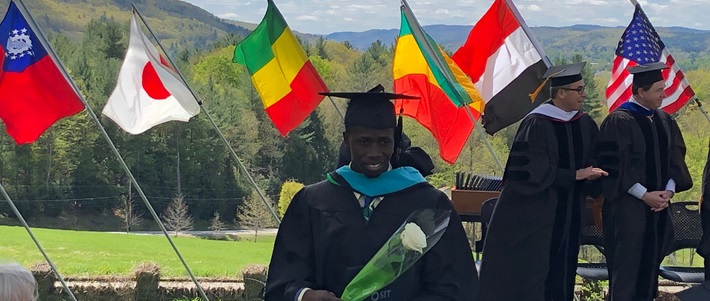
In 2019, after completing a Fulbright Master of Arts in Sustainable Development at the School for International Training in Vermont, with a focus on Monitoring, Evaluation, Learning, and Research, Sekou returned to Guinea. Since then, he has worked primarily as Executive Director, building the organization’s systems, partnerships, and programs. Jeune Espoir has developed into a multi-program organization anchored in Powerful Blended Learning, English, Digital Literacy and Intercultural Skills, and Sustainable Livelihood Identification and Creation.
Under his leadership, Jeune Espoir strengthened registration, board development, strategic planning, fundraising, staff coaching, and partnerships with organizations including Digital Promise and Learning Equality. The organization also installed digital infrastructure, including computer laboratories and Kolibri servers in partner schools.
The results are tangible. Young Guineans have participated in U.S. exchange programs; 48 adolescents are enrolled in the English Access Microscholarship Program; primary pupils are learning English through active, blended methods; and SLIC participants have launched poultry enterprises with training, technical coaching, equipment, and seed capital.
Sekou’s leadership received external recognition in 2025 through the Excellence in Education and English Language Award at the USA–Guinea Alumni Forum. Jeune Espoir was also featured by Digital Promise during UNESCO’s International Day of Digital Learning for expanding access to quality education in low-connectivity environments.
Today, Sekou continues to lead Jeune Espoir from Dalaba, focused on deepening impact rather than chasing scale for its own sake. His work remains guided by a simple conviction: when young people are equipped and accompanied, they can build futures worth staying for. He set out to serve his community faithfully with the resources at hand. That choice shaped his own transformation—and enabled him to author transformation in others.