
About Us
Our target audience, worldview and values, history, and Theory of Change.
Our Target Audience and the Particular Problem They Face
We work with primary and secondary teachers in rural areas in Guinea to help children and adolescents reach their full potential. The education system generally focuses on rote memorization. Students are taught to remember information but are not pushed toward higher levels of learning: application, analysis, evaluation, and creation. Cities located upcountry also receive fewer qualified teachers, exacerbating inequities.
This education system leads to poor learning outcomes. For example, 83% of Guinean children of late-primary-school age are not proficient in reading. Only 6% of the population aged 25 and above attain tertiary education. It also limits children from becoming critical thinkers and applying what they learn to create or secure employment. Despite these challenges, rural students are resilient and often do everything they can to succeed and contribute to their communities.
We also work with unemployed rural Guinean youth, giving them opportunities to prosper in place despite poor education and unfavorable economic policies and practices. Unemployment and underemployment create hopelessness and a strong desire among even highly educated young people to leave Guinea, contributing to brain drain.
Our Worldview and Values
Jeune Espoir begins by changing minds, challenging assumptions, and seeing things differently.
- Society says the goal is to become rich; JE says to be responsible for what God has given you.
- Society says you are poor; JE says you have resources that can allow you to prosper.
- Society says you are worthy of more respect the wealthier or more powerful you are; JE says the poor and rich alike are created in the image of God, and that honesty, humility, justice, and love deserve respect.
- Society says you have to go along to get along; JE says you should never compromise your integrity.
- Society says you are a consumer and happier the more you buy; JE says you are a steward responsible to God and the community for the resources you produce and consume, and happier the more you love and serve others.
- Society says there is nothing you can do until someone gives you a handout; JE says you can begin by developing what you already have.
- Society says Africans are victims of exploitation and colonialism and nothing will change until the West acts justly; JE acknowledges injustice while affirming the freedom and responsibility to advance despite it.
- Society says “spend it now”; JE says “invest it for the future.”
- Society says manual labor is less worthy than intellectual or managerial work; JE says all honest and hard work is equally worthy of respect.
- Society says wealth is fixed and another person’s prosperity makes you poorer; JE says wealth can grow and that wider prosperity strengthens society.
- Society says start big to make it big; JE says start small, be faithful with little, and you will be entrusted with more.
- Society says women are for the benefit of men; JE says women and men alike are created in the image of God and charged to develop creation in love toward God and others.
- Society says what is imported from the West is always better; JE says what is African-made can be just as good or better.
Our History
In the summer of 2006, a forerunner of Jeune Espoir—Jeunesse Espoir—came into being. Four college students from North America led a six-week program at Centre Espoir for 15 Guinean youth selected through an application process. Participants learned computer skills and English, studied and debated current issues, performed community service, and visited NGOs and private enterprises contributing to their communities.
Sekou Mansaré was one of those participants and later founded Jeune Espoir in 2014. In 2008 and 2009, he and his friends began managing the computer-skills training center at Centre Espoir. This work developed into a cybercafé, English-learning activities, live English classes, after-school tutoring, homework support, and preparation for national examinations.
Jeune Espoir now carries forward much of the work begun at Centre Espoir. Through its three integrated programs, the organization equips Guinean youth to participate in and contribute to the global economy from Guinea, helping break cycles of unemployment, poverty, and emigration.
Our Theory of Change
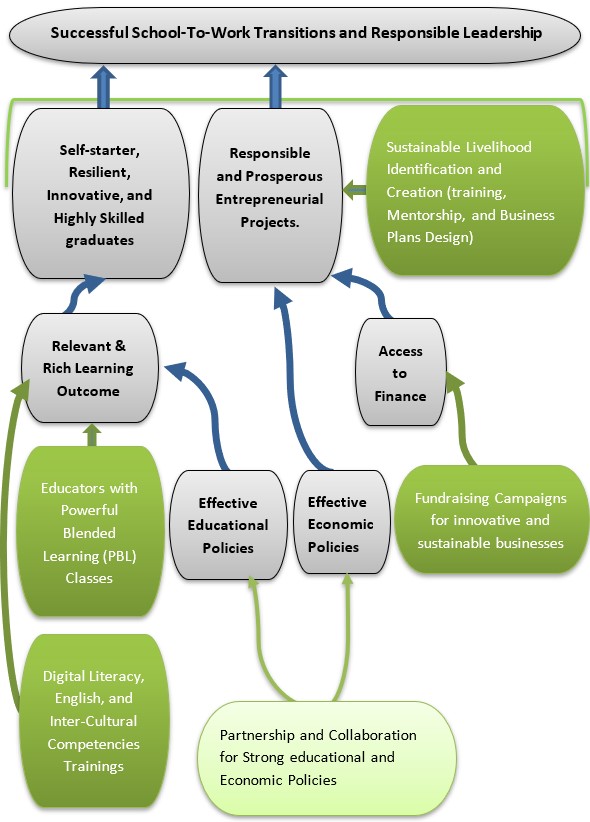
A Theory of Change defines or redefines an initiative’s goal and maps backward to identify the preconditions necessary for success.
Our Theory of Change identifies the impact we seek in as many Guineans as possible: successful school-to-work transitions and responsible leadership. Relevant and rich learning outcomes are essential for graduates to become self-starters, resilient, innovative, and highly skilled. Skilled, analytical, and environmentally conscious entrepreneurs who have access to funding are necessary for responsible and prosperous entrepreneurial projects.
To produce relevant and rich learning outcomes, we introduce teachers to Powerful Blended Learning, equip students with English, digital-literacy, and intercultural competencies, and build locally relevant digital educational resources. To develop capable entrepreneurs, we take youth through the Sustainable Livelihood Identification and Creation program and support fundraising campaigns that increase access to finance.